
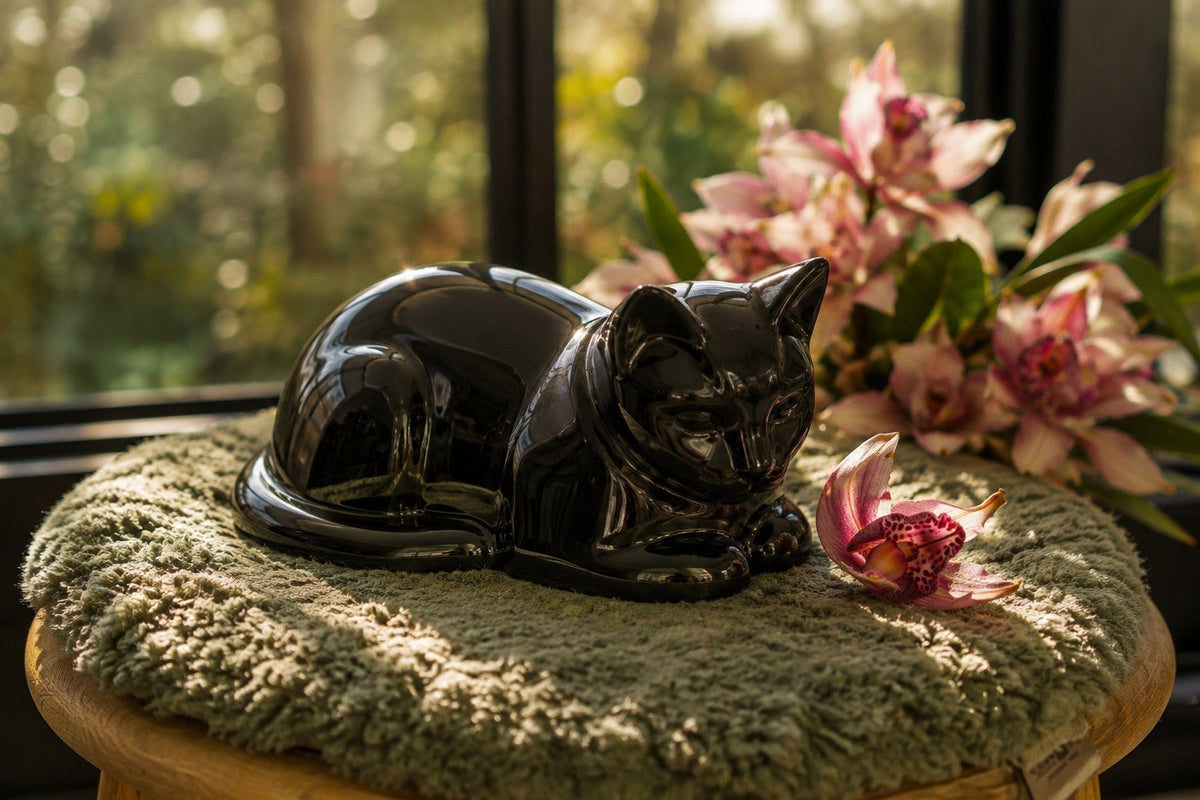
There is a particular expectation attached to grief: that, with enough time, it should become smaller. The first days are supposed to be the hardest, then the weeks, then the months. Eventually, the assumption goes, the pain should soften into something manageable. We may still miss our pet, but we should be able to think about them without the same heaviness.
Sometimes that happens. But grief does not always follow such a straightforward path.
For many people, losing a pet does not mean gradually feeling less. It means feeling differently. The sharpness of the absence can change, but the relationship does not necessarily disappear with it. What was once an everyday presence becomes a memory, a photograph, a familiar name, an object kept in a drawer, or an urn resting somewhere in the home. The grief changes because life changes around it. And sometimes, that is what “getting better” actually means.
The First Absence Is Physical
When an animal dies, one of the first things we notice is not necessarily the emotion itself. It is the interruption of ordinary life. There is no one waiting at the door. The food bowl remains untouched. The bed is empty. There is no movement from the other room, no familiar sound at a particular hour, no reason to get up and check whether the dog wants to go outside or the cat has found its usual place to sleep.
For years, these small actions may have been so automatic that we barely considered them. Then suddenly they have nowhere to go.
This is one reason the first stage of grief can feel so disorienting. We are not only missing a living being. We are adjusting to a life that has lost hundreds of tiny routines. The mind continues to expect them. You may walk into a room and instinctively look toward the place where your pet used to sleep. You may still listen for their movements or almost reach for the door before remembering that there is no longer anyone waiting on the other side.
Eventually, those automatic expectations begin to fade. But that does not necessarily mean the attachment has faded with them.

Then the Silence Changes
At some point, the house becomes familiar again. This can feel like a betrayal.
The first time you realise you have gone through an entire morning without crying, you may feel guilty. The first time you laugh about something without immediately thinking that your pet is no longer there to see it, you may wonder whether you are forgetting.
But grief is not measured by how consistently unhappy we remain. The fact that life becomes ordinary again does not mean the relationship has become unimportant. It means the mind is learning how to carry the absence.
There is a difference between forgetting someone and no longer being overwhelmed by their absence. In the beginning, your pet's death may occupy almost every thought. Later, they may appear in your mind less frequently, but when they do, the memory can be unexpectedly vivid. A photograph can stop you. A familiar sound can bring something back. Someone mentioning their name can suddenly make an ordinary conversation feel very far away.
The grief has not disappeared. It has become less constant and more unpredictable.
The Strange Way Time Works in Grief
Grief is often described as something linear because time itself is linear. But memory is not.
A person can be perfectly fine for weeks and then experience an intense wave of sadness because of something seemingly insignificant. It might be the changing season, the smell of a particular blanket, a favourite toy found while cleaning, the date of an adoption anniversary, the first Christmas without them, or simply a moment when the house becomes unusually quiet.
These experiences can feel confusing because there may be no obvious reason for them to happen at that particular moment. But memories are connected to far more than dates and photographs. They are connected to places, sounds, objects, routines and sensations.
This is why grief can return long after the initial loss. Not because we have failed to move forward, but because a particular part of the past has suddenly become present again. Sometimes the emotion attached to that memory is just as real as it was years earlier.
An Urn Can Change Meaning Over Time
This is one of the quieter aspects of pet memorialisation.
Immediately after a loss, an urn can carry an enormous emotional weight. It may be difficult even to look at it. It represents something that has happened but still feels impossible to accept. It can make the reality of death feel tangible in a way that photographs and memories sometimes do not.
But the meaning of the urn can change.
At first, it may be associated almost entirely with loss. Later, it may become associated with remembrance. Eventually, for some people, it simply becomes part of the home.
It might sit on a shelf, beside a photograph, among books or in a dedicated place. It no longer necessarily represents the moment of death. Instead, it becomes one of the objects that belongs to the story of a life that was shared.
This transformation can happen quietly. One day, looking at the urn may feel unbearable. Years later, it may bring a strange sense of closeness. That does not mean the loss has become meaningless. It means the object has acquired a different place within the relationship.

Grief Can Become Less About the Death
Perhaps one of the most significant changes is the moment when memories begin to contain more than the final days.
Early grief often pulls attention toward the ending: the illness, the final goodbye, the last time you saw them, the empty space afterward. But with time, other memories can begin to occupy more room.
You remember the first day they came home. The ridiculous thing they used to do when they were excited. The place they always chose to sleep. The way they looked at you when you came back from work. The particular sound they made when they wanted something. The ordinary Tuesday that you never knew would eventually become a precious memory.
Gradually, the story becomes larger than the loss itself.
Your pet's life is no longer defined only by the fact that it ended. It becomes possible to remember the life that came before. And there is something important in that shift.
We Don't Necessarily “Move On”
The phrase “move on” can make grief sound like a destination, as though there is a point at which we leave the relationship behind and continue without it.
But losing a pet does not erase the years in which that animal was part of your life. Their routines may have shaped your mornings. Their presence may have influenced where you lived, how you spent weekends or how you organised your home. You may have grown alongside them.
Perhaps they were there during university, a difficult relationship, a move to another city, a new job, a marriage, children or simply years of ordinary life. When the animal dies, all of those experiences remain.
The relationship changes, but it does not become irrelevant.
In this sense, grief may be less about moving on from an animal and more about learning to carry their absence alongside everything else that continues.
Some Memories Become Easier. Others Don't.
There is also no rule that says every memory must eventually become comforting.
Some memories may always hurt. A particular photograph might remain difficult to look at. A final video might never become something you can watch casually. An object may stay in a box because seeing it feels too personal.
Other memories may become unexpectedly funny. You may eventually laugh at the same behaviour that once made you exasperated. You may tell someone a story about your pet and realise that you are smiling halfway through it.
Both reactions can exist at the same time.
Grief does not require us to choose between sadness and happiness. The same memory can contain both. You can miss an animal deeply and still be grateful that their life happened. You can feel pain when you see their photograph and still want to keep it. You can look at an urn and be reminded of death while also feeling comforted by the fact that something tangible from their life remains with you.
There is no contradiction in this. It is simply what happens when love and loss occupy the same memory.

The Day You Realise You Are Remembering, Not Just Missing
Perhaps one of the clearest signs that grief has changed is when the memories stop being entirely about absence.
At first, you remember your pet and immediately think: They're gone.
Later, you may remember them and simply think: That was them.
The difference is subtle, but enormous.
The memory no longer exists only as evidence of what you lost. It becomes evidence of what you had.
That shift does not happen according to a schedule. For some people it takes months. For others, years. For some memories, it may never happen completely.
But when it does, grief can become quieter without becoming smaller. The sadness is still there. It simply has more memories around it.
Why Certain Days Still Hurt
There may still be days when grief returns with surprising force.
Anniversaries can do it. Birthdays. Holidays. The first snowfall. A familiar route. Seeing another animal that looks almost exactly like yours. Sometimes there is no identifiable trigger at all.
These moments do not necessarily mean that you have gone backwards.
They are reminders that grief is not something we complete and then leave behind. It is something that can become woven into the larger story of a life.
The intensity can change. The frequency can change. The way we experience it can change. But certain attachments remain meaningful precisely because they mattered so much.
The Pet We Lost Is Not the Same as the Memory We Keep
There is an important distinction between preserving a memory and trying to recreate the past.
A photograph cannot bring an animal back. Neither can an urn. Neither can a favourite toy, collar or blanket.
These objects do something different. They give memory a physical form.
An urn can occupy a place in the home. A photograph can remain on a shelf. A collar can be held years later. They do not replace the animal. They remind us that the animal existed in a very real, physical world and that we were part of that world too.
This may be why memorial objects can become increasingly meaningful as time passes. They do not have to keep grief alive. They can simply give remembrance somewhere to exist.

Perhaps “Easier” Was Never the Right Word
We often ask whether grief gets easier. Perhaps a better question is whether we become different people carrying it.
The house changes. Our routines change. Our memories change. The objects connected to our pet change meaning. Even the way we speak about them can change.
At first, we may struggle to say their name. Later, we may tell stories about them. Eventually, their name may appear naturally in conversation, accompanied by a smile rather than only tears.
None of this means that the animal has become less important. It means that their place in our life has changed.
Their physical presence has become memory. Their routines have become stories. Their belongings have become keepsakes. And for some people, their ashes remain in an urn — a quiet, tangible reminder of a life that once occupied the home in countless ordinary ways.
Grief does not always disappear. Perhaps it was never supposed to.
Some losses become lighter because we learn to carry them differently. Some memories become warmer because enough time has passed for the whole story to return — not only its ending.
And perhaps that is what it means when grief becomes different.
One day, you realise that you are no longer remembering your pet only because you miss them. You are remembering because they were part of your life.
And that is something time does not have to take away.
This tighter paragraph style will be the default for the articles going forward.

Partager:
Why Your Pet’s Smell Can Bring Back an Entire Memory