
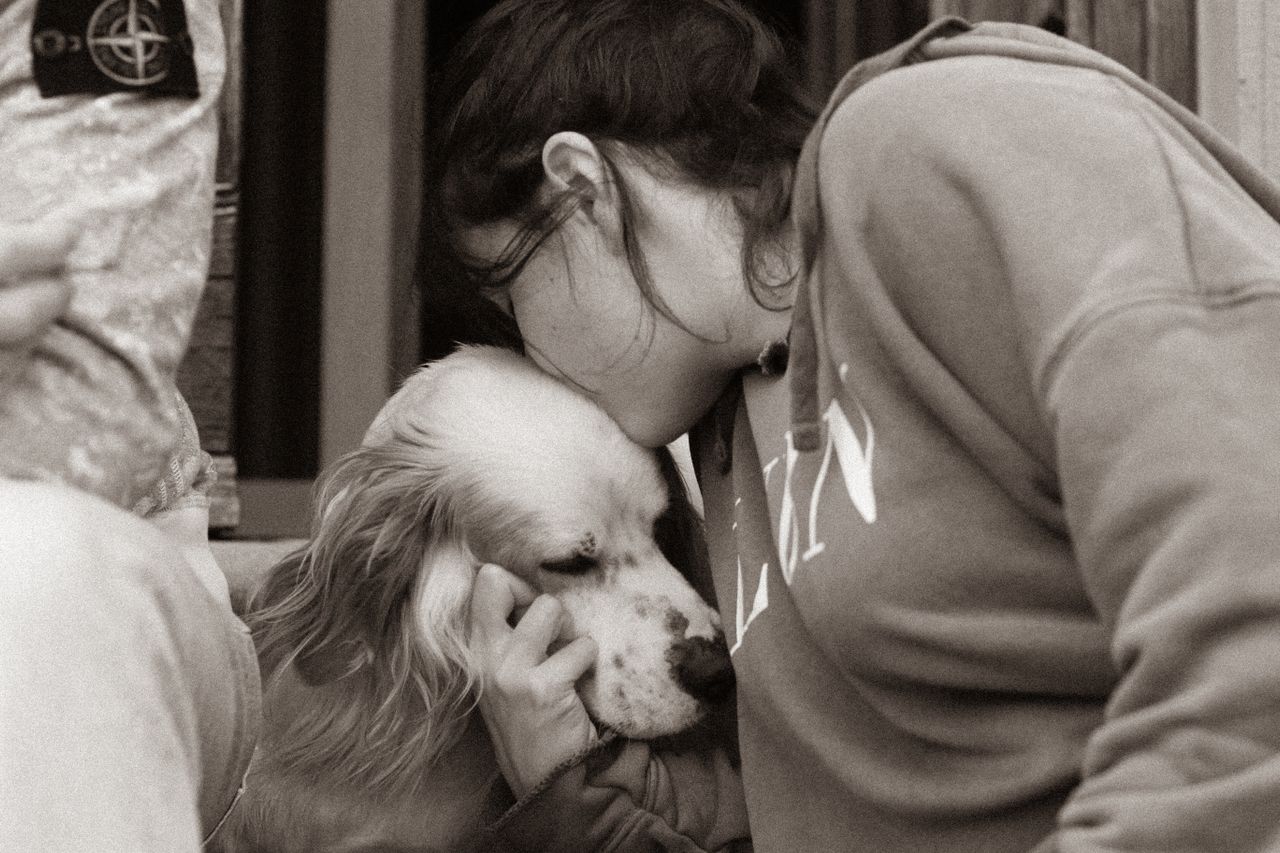
There are memories we can describe, and then there are memories that seem to arrive before words.
A familiar smell can be enough.
For someone who has lived with a pet for years, the scent of that animal can be difficult to define. It may be the smell of fur after coming inside from the rain, the scent of a favourite blanket, the particular smell of a collar or simply the familiar presence of an animal in the room. It is not necessarily something we consciously notice while our pet is alive.
But once that presence is gone, its absence can make the smallest sensory details suddenly significant.
A smell can bring back a room. A season. A particular afternoon. Sometimes, almost an entire moment.
This is not simply because smell is closely associated with memory. The relationship between the two is unusually direct.

Of all our senses, smell has one of the closest connections to the parts of the brain involved in emotion and memory. Odours are processed through the olfactory system, which is closely connected with areas including the amygdala and hippocampus. The amygdala plays an important role in emotional processing, while the hippocampus is central to memory formation and retrieval.
This neurological proximity helps explain something many people experience without being able to explain it: a familiar smell can suddenly make the past feel remarkably close.
We may not remember consciously deciding to store that particular scent.
Our brains did it for us.
And when the smell appears again, it can sometimes retrieve much more than the smell itself.
For pet owners, this can be especially powerful.
We live alongside animals in an unusually sensory way. We touch them, hear them moving around the house, notice the sound of their breathing and become familiar with their individual scent. Their smell becomes part of the background of everyday life.
It is there when they sleep beside us.
It is there when they return from a walk.
It is there on their bed, their blanket, their favourite toy.
Eventually, we stop thinking about it.
It simply becomes part of home.
That is what makes its absence so strange.

When an animal dies, people often notice the silence first. The missing footsteps. The empty space on the sofa. The bowl that is no longer being filled.
But there can also be a quieter disappearance: the gradual fading of a familiar scent.
At first, traces of it may remain everywhere. On a blanket. In a bed. On a collar. In the places where the animal used to sleep.
Then, slowly, they become less distinct.
And sometimes a completely unexpected encounter with a similar smell can bring everything back.
A particular fabric. A warm room. The scent of wet grass. A shampoo. A wooden floor after rain.
For a moment, the mind does not simply remember the animal.
It reconstructs the world around them.
This is one of the reasons smell can feel so different from looking at an old photograph.
A photograph gives us an image.
A scent can give us a situation.

It may bring back the sensation of sitting on the floor while a dog sleeps nearby. The feeling of a cat jumping onto the bed in the morning. The atmosphere of a particular home at a particular stage of life.
The memory can arrive as a collection of sensations rather than a clearly narrated event.
Psychologists sometimes describe these experiences as involuntary autobiographical memories: memories that appear spontaneously, without deliberate effort. Odours can be particularly effective triggers for these memories, sometimes producing vivid recollections accompanied by strong emotional responses.
This is also why a smell associated with a pet can feel surprisingly personal.
Someone else may encounter the same scent and notice nothing unusual.
For us, it can be unmistakable.
That difference comes from association.
The scent does not have to be objectively distinctive. What matters is that the brain has connected it with repeated experiences. Over years, an animal's smell becomes intertwined with routines, places, touch and emotion.
The pet is therefore not remembered through scent alone.
The scent becomes a key that opens a much larger network of memories.
This may help explain why people sometimes find themselves unexpectedly emotional when they discover an old blanket or piece of clothing that still carries a trace of a pet's scent.
The object itself may be ordinary.
What it contains is not.
It represents a period of life in which the animal was physically present.
And scent has another quality that makes these experiences particularly powerful: it is difficult to put into words.
We can describe the colour of a dog's fur or the shape of a cat's face. We can explain how an animal used to sleep or where they liked to sit.
It is much harder to describe exactly what they smelled like.
Perhaps that is partly why the memory can feel so intimate.
It belongs to experience rather than language.
There is also something unusual about the way animals become associated with the physical spaces around us. A pet does not exist only as an individual creature. They occupy rooms, furniture and routines.

They leave traces.
A favourite corner becomes their corner. A blanket becomes theirs. A particular part of the sofa becomes associated with the shape of their body.
Their scent participates in this process.
Over time, the animal's presence becomes woven into the sensory identity of the home.
That is why losing a pet can change the atmosphere of a familiar place so dramatically. Nothing about the walls may have changed, yet the house feels different.
The sounds have changed.
The routines have changed.
The smells have changed.
The person who used to occupy the space is no longer there.
In this sense, grief is not only emotional. It can be remarkably physical.
The brain and body have become accustomed to the presence of another living being. We expect to hear them, see them and encounter them. We have built countless small predictions around their existence.
And smell can be part of those expectations.
Perhaps this is why a familiar scent can create such a strange moment after loss. For an instant, the brain receives information that belongs to the past, while the rest of the world remains in the present.
The result can feel almost like a brief return.
But it is not really a return.
It is memory doing something extraordinary.

This also explains why people preserve objects belonging to their pets even when those objects have little practical value. A collar, toy or blanket can become meaningful because it carries associations that cannot be replaced by a new object.
Its importance is not necessarily material.
It is relational.
The object belonged to a life that was shared.
Sometimes, people keep these objects because they are not ready to let go. At other times, they simply want to keep something that still feels connected to the animal.
There is no universal way to decide what should be kept and what should be discarded.
A collar may mean nothing to one person and everything to another.
A blanket may eventually become too painful to keep, while a photograph may become a source of comfort.
Memory does not follow a single system.
And perhaps we should not expect it to.
Modern technology gives us extraordinary ways of preserving visual and audible records of our pets. We can save thousands of photographs, hours of video and recordings of their voices. We can preserve their appearance in extraordinary detail.
But scent remains much more difficult to archive.
There are technologies that attempt to identify, analyse or reproduce smells, but the everyday scent of an individual animal is not something we can simply save in a digital folder.

It exists differently.
It is experienced rather than displayed.
This may make scent one of the most elusive parts of an animal's memory.
We can watch the way they walked.
We can hear the sound they made when they wanted attention.
We can see their face.
But remembering exactly how they smelled can be much harder — until something unexpectedly brings it back.
And when it does, the memory may be remarkably complete.
Not because the smell contains the entire past, but because our brain has connected that sensory experience to everything that surrounded it.
A familiar scent can therefore remind us not only of an animal, but of ourselves when that animal was still alive.
The home we lived in.
The people around us.
The routines we followed.
The person we were at that particular point in our life.
This is perhaps the most fascinating part of memory: when we remember our pets, we are often remembering a version of our own lives alongside them.
An animal may have been present during university years, a first apartment, a relationship, a move to another city, the arrival of a child or simply a long period of ordinary days.
Their life becomes part of our personal timeline.
Their scent can sometimes unlock that timeline without warning.
A smell enters the room, and suddenly we are somewhere else.
Not literally, of course.
But memory can make the distance feel surprisingly small.
Perhaps this is why the sensory details of our pets deserve more attention while they are still with us. Not because we need to anticipate their absence, but because so much of companionship is made up of details we rarely think to record.
The warmth of their fur.
The sound of their breathing.
The weight of their body beside us.
The particular smell that belongs only to them.
These things seem insignificant while they are part of everyday life.
Later, they may become some of the most intimate memories we have.
A pet's scent is therefore more than a physical characteristic. Through years of familiarity, it becomes part of how we recognize their presence and how our brain organizes memories of life with them.

And perhaps this is why an unexpected smell can sometimes stop us in the middle of an ordinary day.
For a moment, the past does not feel like a distant collection of photographs.
It feels close enough to touch.
The smell disappears almost as quickly as it arrived.
The room becomes ordinary again.
But for those few seconds, something has returned — not the animal itself, but a fragment of the world that existed when they were still there.
And sometimes, that fragment is enough to remind us just how deeply an animal can become part of the life around us.
Partager:
Can You Recognize Your Pet’s Personality in Their Face?