
For a long time, saying goodbye to a pet was treated as something simple and private.
There might be a final visit to the veterinarian, a burial somewhere familiar, or a quiet moment at home. There were few expectations surrounding what should happen afterward. Pet loss was often considered a personal sadness rather than something that required its own rituals.
That is changing.
As pets have become increasingly recognized as members of the family, the way we say goodbye to them is changing too. Cremation, memorial ceremonies, personalized urns, keepsakes and dedicated spaces for remembrance are becoming part of a new culture of pet loss.
The modern pet funeral is no longer necessarily about following a tradition.
It is about creating one.
From “Pet” to Family Member
The way we say goodbye to someone is closely connected to the place they held in our lives.
When animals were primarily viewed as companions, working animals or household pets, their deaths were often approached differently from the loss of a human family member. Today, that distinction is becoming less straightforward.
Dogs and cats live inside our homes. They sleep beside us, accompany us through daily routines and are present during important chapters of our lives. For many people, they are among the most consistent relationships they have.
Their loss can therefore create a form of grief that deserves recognition.
A funeral or memorial is one way of acknowledging that significance.
It does not mean pretending that an animal and a human have identical lives. It means recognizing that the emotional relationship can be profound — and that profound relationships often need meaningful goodbyes.

The Rise of Personalized Goodbyes
There is no single way to say goodbye anymore.
Some people choose a quiet ceremony with close family. Others want to mark the occasion with photographs, flowers, music or a few words about their pet's life. Some may choose cremation and keep the ashes in a carefully selected urn. Others may create a memorial space at home or choose another way of preserving their companion's memory.
The important change is not that everyone is beginning to hold elaborate funerals.
It is that people increasingly feel allowed to choose.
The farewell can reflect the personality of the animal and the relationship they shared with their family.
A playful dog does not have to be remembered through something formal. A quiet cat does not need an elaborate ceremony. A pet who spent fifteen years at the center of family life may deserve a farewell that acknowledges those fifteen years.
Modern memorialization is becoming less about what is traditionally expected and more about what feels emotionally honest.

Cremation Has Changed What a Goodbye Can Look Like
Cremation has introduced another possibility into the way people remember their pets.
Instead of a goodbye that ends at the funeral or burial, cremation allows remembrance to continue in a physical form.
The ashes can be kept in an urn, giving families the possibility of keeping their companion close. The urn itself can become part of the memorial — something selected not simply for its function, but for what it represents.
This has changed the role of the urn.
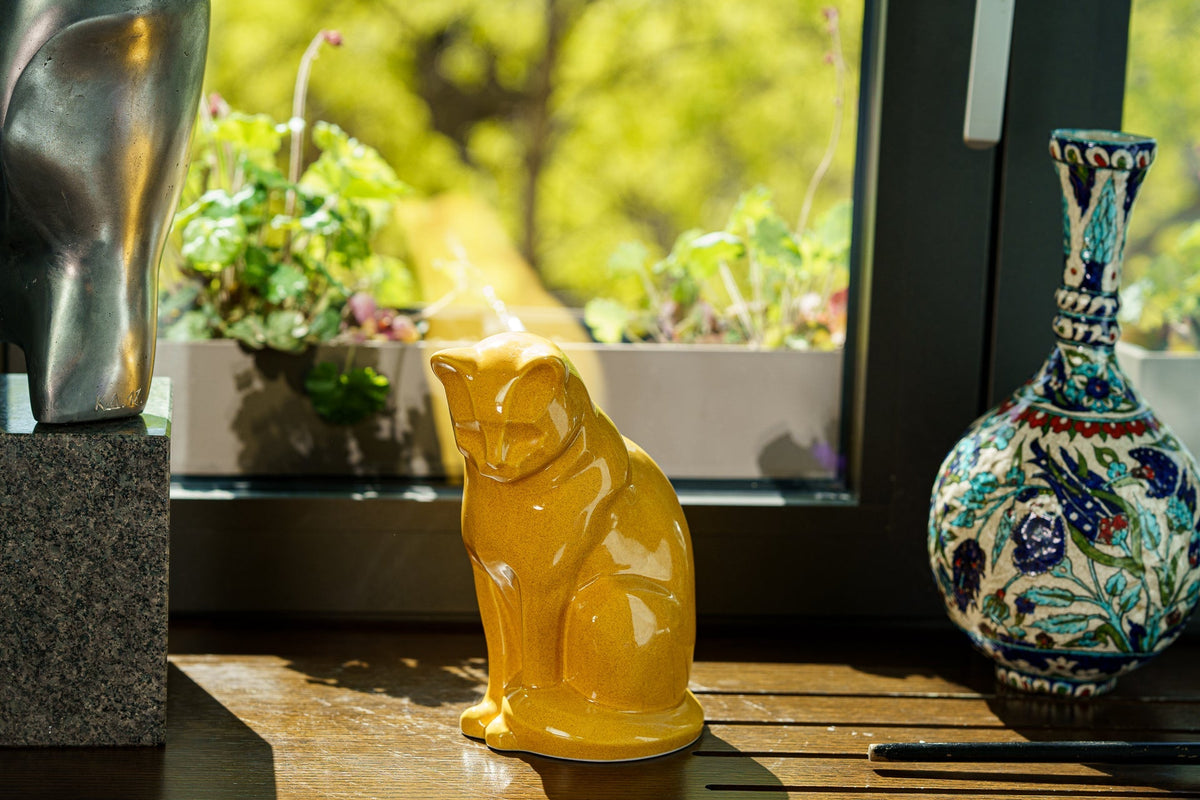
It is no longer necessarily something hidden away or treated as a purely practical funeral object. Contemporary pet urns can be designed as objects that belong naturally within a home and reflect the individuality of the animal they commemorate.
The goodbye, in other words, does not necessarily have to mean letting go of every physical connection.
Sometimes it means finding a new form for that connection.
The End of the “One-Size-Fits-All” Funeral
Human funerals have long been shaped by religious, cultural and family traditions.
Pet funerals have far fewer fixed rules.
That can be surprisingly meaningful.
There is no universal script telling an owner exactly what they should do. A family can create a farewell that is deeply private or openly ceremonial. They can choose simplicity or something more elaborate. They can mark the death immediately or take time before creating a memorial.
This freedom reflects something important about modern grief: there is no single correct way to mourn.
The most meaningful goodbye may be the one that feels most connected to the life being remembered.

When the Home Becomes the Memorial Space
Another significant change is happening after the funeral itself.
For many people, remembrance does not belong exclusively to a cemetery or formal memorial site. It becomes part of the home.
An urn can sit among family photographs. A portrait can remain on a shelf. A collar can be kept in a special place. A favorite toy can become something that nobody wants to put away.
The home begins to contain traces of the animal's life.
This can initially feel painful. But over time, these objects can become less about absence and more about continuity.
The pet is no longer physically present, but the relationship still occupies a place within the family.
A New Kind of Memorial Culture
The evolution of pet funerals reflects a much larger cultural change.
We are living in a time when the boundaries between “pet” and “family” have become increasingly fluid. People spend more of their lives with animals, invest heavily in their wellbeing and often describe them using the language of family relationships.
It makes sense, then, that their deaths are also receiving more thoughtful rituals.
This does not mean turning every pet funeral into a miniature human funeral.
It means developing forms of remembrance that belong specifically to the human-animal relationship.
The result is a new memorial culture — one that can include cremation, urns, ceremonies, photographs, art and personal rituals without requiring any of them to be mandatory.
Why Ritual Matters
A funeral does something that a private feeling cannot always do.
It creates a moment.
It marks the transition between one reality and another: the life when the pet was physically present and the life that follows.
For people grieving an animal, that moment can be important.
The ritual does not have to be elaborate. It might simply mean holding the pet one last time, saying goodbye, gathering the people who loved them, lighting a candle or choosing an urn that feels worthy of their memory.
What matters is the acknowledgment.
A life existed.
A relationship existed.
And it deserves to be marked.

Saying Goodbye Without Erasing the Relationship
Perhaps the most significant change in modern pet funerals is the understanding that a farewell does not have to mean forgetting.
For generations, the language around death has often suggested finality: closure, letting go, moving on.
But grief does not always work that way.
The relationship with a pet can continue in a different form. We remember their habits. We tell stories about them. We keep their photographs. We recognize their personality in memories that become part of our own history.
A memorial object can support that process.
An urn does not preserve the animal as they were in life. It preserves something different: a physical connection to a relationship that still has meaning.
The Future of Pet Goodbyes
The modern pet funeral is still evolving.
As attitudes toward animals continue to change, so will the ways in which we commemorate them. Future generations may consider personalized pet funerals, memorial art and beautifully designed urns as ordinary parts of saying goodbye.
What once seemed excessive may simply become another expression of love.
And perhaps that is the most important change of all.
A pet funeral is not really about making an animal's death resemble a human funeral.
It is about recognizing that when an animal has been part of someone's family, their absence can leave a very real space behind.
That space deserves acknowledgment.
The way we say goodbye is changing because the way we understand our relationships with animals has changed.
Today, a goodbye can be quiet or ceremonial, traditional or completely personal. It can end with a burial, continue through cremation, or take shape through an object that remains in the home.
There is no single definition of the perfect farewell.
There is only the one that feels right for the life that came before it.
And perhaps that is what the modern pet funeral ultimately represents: not simply the end of a life, but the beginning of a different way of remembering it.

Share:
Can the Design of a Pet Urn Change the Way We Grieve?