
We rarely think about impermanence while something is still part of our everyday life.
A pet is there in the morning, waiting for breakfast. There are walks, bowls, toys, familiar sounds and small routines that seem too ordinary to deserve attention. Their presence becomes woven into the structure of the home so completely that it can be easy to forget that it is not permanent.
But perhaps that is one of the quiet lessons of living alongside an animal: everything we love is temporary, even when it feels deeply familiar.
Learning to Live With Time
Animals experience time differently from us, but living with them makes us unusually aware of it.
We notice a puppy becoming an adult, a young cat becoming slower, a once energetic companion beginning to sleep for longer. Years become visible through changes that might otherwise pass unnoticed.
Their lives remind us that time is not simply something measured by calendars. It is also measured through bodies, habits and relationships.
A favourite place on the sofa changes. A walk becomes shorter. A routine that once seemed permanent gradually becomes a memory.
In this way, having a pet can make the passage of time tangible.

The Meaning of Something Because It Will End
Impermanence can be difficult to accept because we often associate permanence with value.
We tend to imagine that something matters most when it can last forever. But the opposite can also be true.
A morning walk matters partly because it cannot happen in exactly the same way forever. The sound of paws approaching the door, the excitement of seeing a familiar face and the ordinary rituals shared over years become precious precisely because they belong to a particular period of life.
Knowing, consciously or unconsciously, that an animal's life is shorter than our own changes the meaning of these moments.
The ordinary becomes significant.
When Routine Becomes Memory
Much of what we remember about a pet is made from repetition.
The same bowl placed in the same place. The same sound at the door. The same sleeping position. The same walk taken so many times that the route no longer requires thought.
While these things are happening, they rarely feel like memories. They feel like life.
Only later do we understand that repetition was creating something we would eventually miss.
This is one of the strange qualities of impermanence: we often recognise the value of a moment only after it has stopped being ordinary.
What Remains When the Routine Ends
When an animal dies, the most noticeable absence can initially be found in the smallest things.
The house becomes quieter. A particular corner is empty. A familiar routine no longer has a reason to happen. Objects that once belonged to everyday life suddenly acquire another meaning.
A collar becomes a reminder. A toy becomes an artifact. A photograph becomes more than a photograph.
The physical traces of an animal can begin to function as a kind of map of the life that was once there.
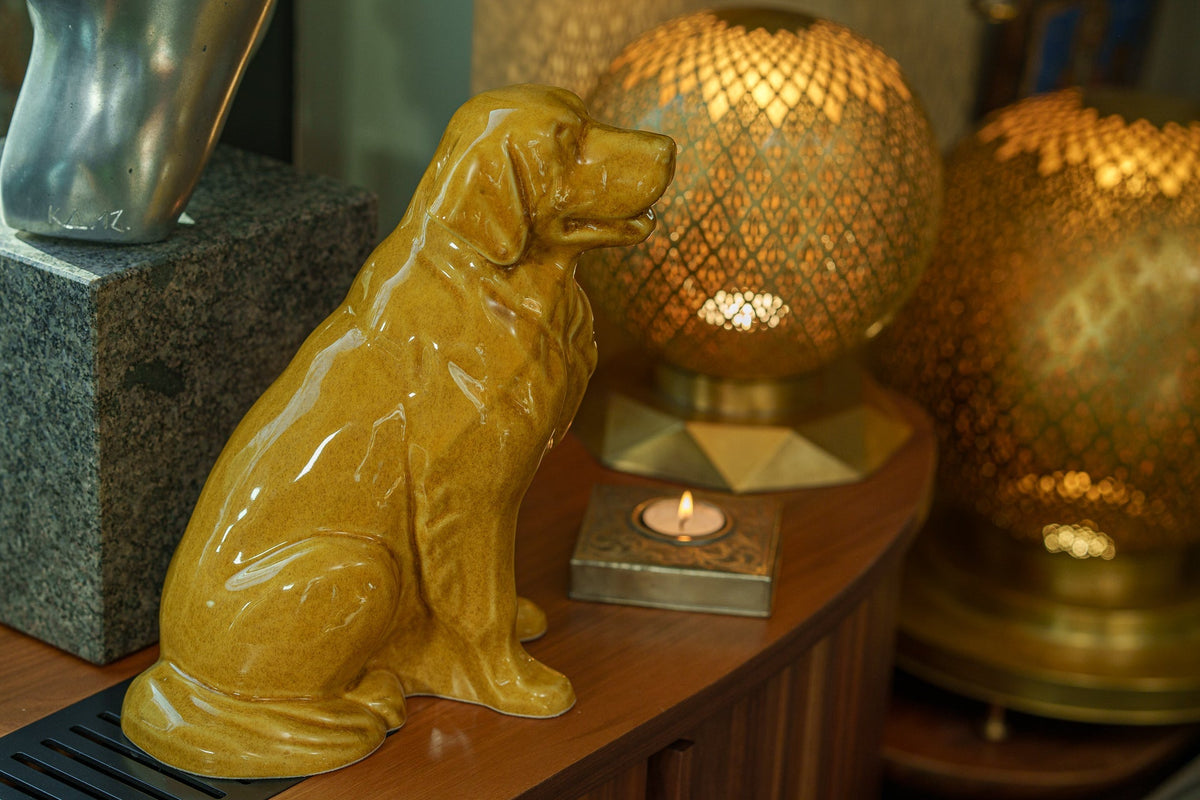
Among these objects, an urn occupies a particularly unusual position.
Unlike many of the things associated with a pet, it is not something left behind accidentally. It is intentionally created to preserve what remains after life has ended. Its physical permanence stands in contrast to the impermanence that surrounds it.

The Urn as an Object of Continuity
An urn cannot stop time, and it cannot restore the presence of an animal.
Its significance lies somewhere else.
As a vessel, it holds what remains physically. As a memorial object, it can also become a quiet point of continuity between the past and the present.
The animal's life was temporary. The relationship, however, does not necessarily end at the same moment.
Memory continues to change and develop. Stories are told again. Photographs are revisited. Familiar habits remain in the mind. The places associated with an animal can continue to carry meaning.
An urn becomes part of this continuing relationship by giving it a physical point of reference.
It does not attempt to deny impermanence. Instead, it acknowledges it.
The Beauty of Things That Do Not Last
There is a particular beauty in objects and relationships that are understood to be temporary.
Flowers are beautiful partly because they fade. Seasons become meaningful because they change. A childhood home can become important precisely because it belongs to a period that cannot be returned to.
Animals teach us the same lesson in a more intimate way.
Their lives are finite, but their presence can influence the way we understand an entire period of our own lives.
A pet may teach someone patience, responsibility, tenderness or simply the value of having another living being beside them every day. These lessons do not disappear when the animal does.
What was temporary can leave something lasting.
Impermanence Does Not Mean Meaninglessness
Perhaps the most important lesson is that impermanence and meaning are not opposites.
Something does not have to last forever to matter.
A pet's life can be measured in years, but its significance cannot be measured in the same way. The length of a relationship does not determine its emotional weight.
This is why memorialisation matters. It is not an attempt to make something temporary permanent in every sense. That would be impossible.
Instead, it gives a temporary life a lasting place within memory.
The object becomes a reminder that something existed, mattered and changed the people who experienced it.
Designing for What Remains
This also changes the way we might think about memorial objects.
An urn does not need to recreate the past literally. It does not need to look like the animal or reproduce every detail of its personality.
It can simply be made with the idea of permanence in mind.
The weight of the material, the quality of the craftsmanship, the durability of the form and the quiet presence of the object all contribute to a different kind of meaning. The urn becomes something designed to remain while the life it commemorates has passed.
This contrast is powerful.
One existence was temporary. The object created to remember it can endure.

A Different Way of Understanding Goodbye
Perhaps living with a pet teaches us that goodbye is not the opposite of love.
It is one of the consequences of loving something that was never ours to keep forever.
We care for an animal knowing, even if we rarely think about it, that one day its life will end before our own. Yet we choose the relationship anyway. We build routines around it, make space for it and allow its presence to become part of our own story.
That may be the most profound lesson of all.
Impermanence does not make the relationship less valuable. It makes us aware of its value.
An animal's life may not remain in the form in which we first knew it. Its sounds eventually become memories, its routines become stories, and its physical presence becomes something we can no longer reach.
But what it changed does remain.
And sometimes, a carefully made urn becomes a quiet physical expression of that truth: not a way of holding on to the past, but a way of giving what mattered a place to remain.
Partager:
Why the Best Pet Memorials Don't Always Look Like Pet Memorials