
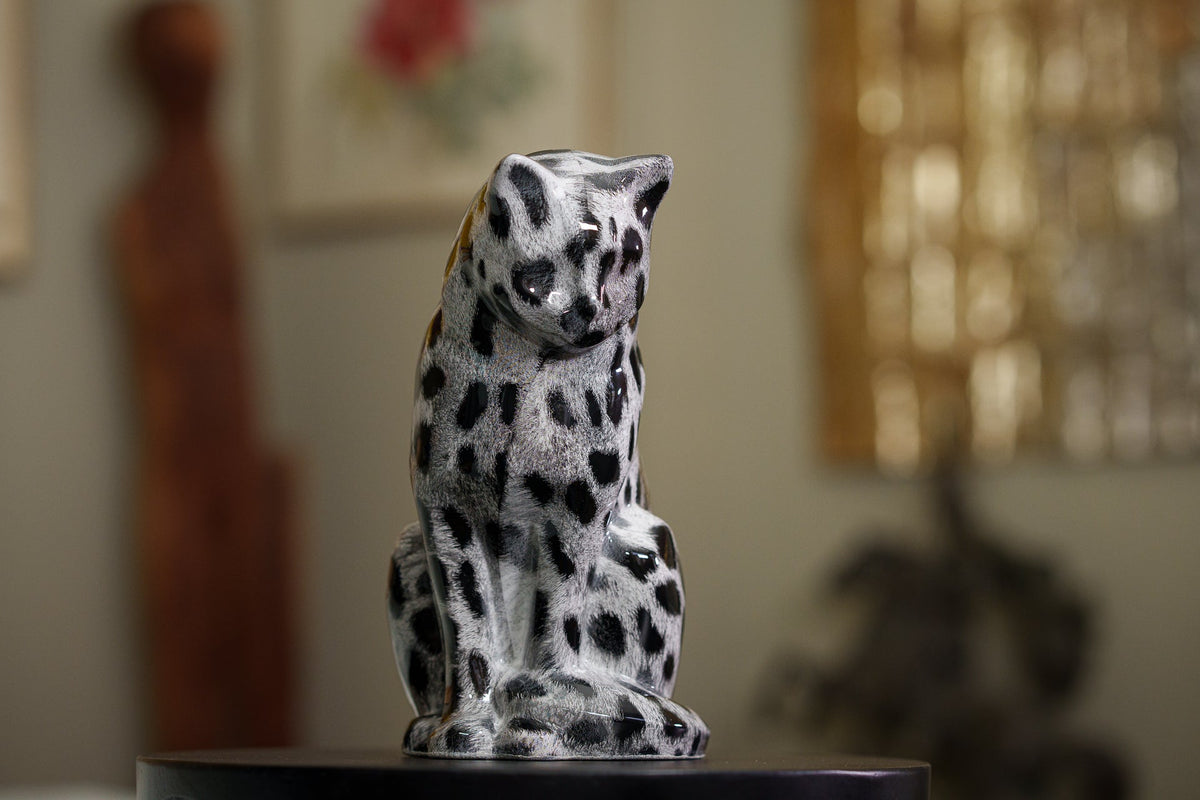
For centuries, the objects we create after death have carried a particular visual language. They are expected to be solemn. Recognisable. Deliberate in their symbolism.
But something is changing in the way we remember animals.
The contemporary pet memorial is increasingly difficult to distinguish from the objects we choose simply because we find them beautiful. A sculptural form on a shelf. A piece of ceramic in a quiet corner. An object whose material catches the light in a particular way. Nothing about it necessarily announces mourning.
And perhaps that is the point.
When an animal has been part of a home for years, remembering it does not necessarily belong to a separate category of life. The memory exists alongside the furniture, photographs, books and objects that have accumulated around the relationship. The memorial, consequently, can do the same.
The result is a new aesthetic of remembrance — quieter, more personal and increasingly connected to the world of contemporary design.

When Mourning Stops Looking Like Mourning
There is an assumption that an object created in response to loss should look serious enough to communicate that loss.
But grief has no universal appearance.
For one person, remembrance may be expressed through something ornate and symbolic. For another, it may be found in a nearly abstract form, a particular material or an object whose meaning is visible only to the person who owns it.
The latter represents an important shift.
A memorial no longer has to explain itself.
It can simply exist.
This allows the object to move away from the conventional aesthetics of funerary culture and closer to the language of art and design — where meaning is not always immediate, and where an object can become significant precisely because of what the viewer brings to it.
The Pet Memorial as a Domestic Object
There is something particular about remembering an animal that once occupied the most ordinary spaces of our lives.
A pet does not belong to a ceremonial room. It belongs to the kitchen, the bedroom, the garden, the sofa. Its life unfolds through the repetitive geography of domestic life.
That makes the home itself part of the memory.
A contemporary memorial can acknowledge this without trying to recreate the animal literally. It can become another object within that environment — something that belongs naturally among the things that make a house feel inhabited.
The distinction matters.
The purpose is not to make death invisible. It is to allow remembrance to coexist with life.
The Quiet Power of an Unfamiliar Shape
Some of the most interesting memorial objects are those that refuse to look exactly like what we expect them to represent.
There may be no paw print. No portrait. No obvious inscription.
Instead, there is shape.
A curve. A surface. A particular balance between weight and delicacy. Something abstract enough to avoid becoming a literal representation, yet distinctive enough to acquire meaning.
This is one of the places where memorial design begins to overlap with sculpture.
Art has long understood that representation does not require imitation. A form can evoke rather than reproduce. It can suggest movement without depicting movement, warmth without depicting a living body, permanence without illustrating eternity.
The same principle can transform the way we think about pet memorials.

The Material Has a Voice
The aesthetics of an object are never only visual.
We experience material through texture, weight, temperature and even the way light moves across a surface. These qualities can give an object an almost physical personality.
Ceramic, for example, carries a particular relationship with the hand and with fire. Stone has an unmistakable sense of density and permanence. Wood introduces grain, warmth and the visible passage of nature. Metal can appear precise, architectural or almost timeless.
For a memorial object, these qualities are not incidental.
They become part of its vocabulary.
The material can quietly communicate something that words cannot: durability, fragility, warmth, stillness or continuity.
It is this attention to material and making that allows a memorial object to move beyond pure function. The same principle can be seen in the work of Pulvis, where urns are approached not merely as vessels, but as carefully crafted objects whose form, surface and material contribute to their meaning.
From Personal Belonging to Personal Meaning
There is also a larger cultural shift behind this new aesthetic.
We increasingly choose objects because of what they say about us. Interior design has become intertwined with identity; ceramics and sculpture have moved from galleries into domestic spaces; functional objects are increasingly expected to possess character.
Memorial objects exist within this same cultural landscape.
A pet urn no longer has to be understood solely through its category. It can be approached as an object of design, craftsmanship and personal significance.
That does not diminish its purpose.
If anything, it acknowledges how complicated that purpose is.
An object can hold ashes and still hold a story.

The End of the “Funeral Look”
Perhaps the most interesting development is not the emergence of one new style, but the disappearance of the expectation that memorial objects should have a single style at all.
There is no longer a necessary visual distance between a memorial and the rest of a home.
A memorial can be understated or expressive. Minimal or richly textured. Almost invisible within a room or deliberately sculptural.
Its value does not depend on how clearly it identifies itself as a memorial.
This creates a different relationship with remembrance. Instead of encountering an object and immediately being told what it means, we may encounter it gradually — through familiarity, association and personal memory.
The object becomes part of the life that continues after loss.
What We Want a Memorial to Look Like
Perhaps the most revealing question is not what a pet memorial should look like, but why we have expected memorials to look a certain way at all.
We have inherited visual traditions for mourning, but our relationships with animals have evolved far beyond the categories those traditions were designed around.
A pet can be a companion, a daily presence, a witness to years of ordinary life. Its absence can therefore be felt not only as a moment of loss, but as a change in the texture of a home and in the rhythm of everyday existence.
The object created in its memory can reflect that complexity.
It does not have to reproduce the past.
It does not have to make grief visible.
It simply has to give memory somewhere to exist.
And perhaps that is where the new aesthetics of pet memorials are heading: away from objects that tell us how to mourn, and towards objects that allow us to remember in our own language.
Not necessarily solemn.
Not necessarily traditional.
Sometimes simply beautiful — because the life being remembered was.

Partager:
Can a Pet Urn Be a Sculpture?