A memorial does not always have to look like what it remembers.
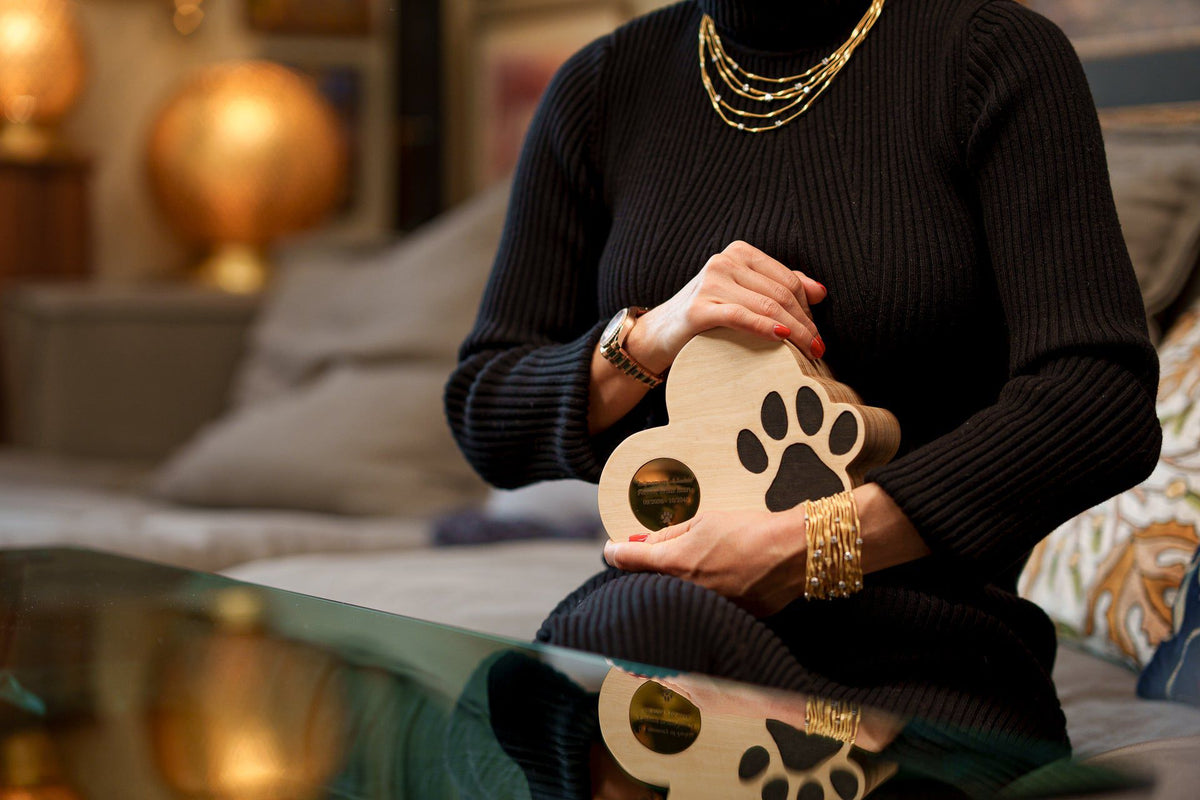
For generations, objects created in memory of someone we have lost have relied on recognizable symbols: names, portraits, dates, flowers, religious motifs, or representations of the person or animal themselves. With pets, the visual language has often been similarly direct. Paw prints, bones, hearts, photographs, and engraved names immediately communicate who is being remembered.
There is nothing wrong with these symbols. They can be deeply personal and comforting. But contemporary memorial design is beginning to ask a different question: does a memorial object have to visibly represent the life it commemorates?
Perhaps not.
Sometimes the most meaningful pet memorial is not the one that looks most obviously like a memorial. It can be an object defined by its form, material, proportion, colour, and craftsmanship—something that quietly belongs within the home while carrying an intensely personal meaning.
Beyond Literal Representation
There is a particular comfort in recognizable symbols. A paw print tells us immediately that an animal is being remembered. A photograph gives the face back to us. A name makes the connection explicit.
But representation and remembrance are not necessarily the same thing.
A pet's personality cannot be reduced to a photograph or a symbol. The animal who followed someone through the house, waited by the door, slept beside their bed, or accompanied them through years of ordinary life was much more than a collection of recognizable images.
This is where abstraction can become powerful.
A curved form might suggest gentleness. A particular colour might recall a favourite blanket, a collar, a room, or simply the character of the animal. A smooth surface can communicate calm, while a more sculptural or irregular form can suggest movement and individuality.
The object does not need to explain itself.
Its meaning can belong entirely to the person who keeps it.

When a Memorial Becomes an Object of Design
The contemporary home has changed the way we think about the objects we choose to live with. We increasingly expect even functional objects to have a visual identity. Furniture, lighting, ceramics, textiles, and everyday accessories are considered not only for what they do but for how they make a space feel.
Memorial objects are part of this changing landscape.
An urn does not necessarily need to be hidden away simply because its purpose is associated with death. It can occupy a visible place within a home, surrounded by the objects and spaces that formed part of everyday life.
This changes the role of the urn.
It becomes more than a vessel. It becomes an object that exists within a living environment.
A contemporary pet urn can therefore be designed with the same attention given to other carefully made objects: proportion, balance, texture, material, colour, and relationship to its surroundings. Its presence can be quiet rather than ceremonial.
And perhaps that quietness is precisely what makes it appropriate.
The Beauty of Subtlety
There is a difference between an object that announces remembrance and one that allows remembrance to emerge gradually.
A highly symbolic memorial immediately tells its story. A more restrained object leaves room for interpretation.
This does not make it less emotional. In some cases, it can make it more so.
A simple ceramic form on a shelf may look like an ordinary piece of art to someone entering the room. To the person who owns it, however, it may represent years of companionship. Its significance exists beneath its appearance.
That distinction is important.
The value of a memorial is not determined by how clearly a stranger understands it. It is determined by what it means to the person who keeps it.

Designing for Personality, Not Just Appearance
Every pet has a distinct character.
Some are energetic and restless, turning every room into a playground. Others are quiet observers, content to remain close without demanding attention. Some animals are elegant and reserved; others are affectionate, mischievous, stubborn, curious, or endlessly playful.
A memorial can reflect these differences without literally reproducing the animal.
This is one of the possibilities offered by design.
The choice of form can evoke softness or strength. Colour can create an association with an animal's surroundings or personality. Texture can make an object feel organic, tactile, smooth, delicate, or substantial.
Even scale can matter.
The intention is not to create an exact portrait. It is to create something that feels appropriate to the memory.
In this sense, designing a pet memorial becomes an exercise in translation: transforming an intangible relationship into a physical object without attempting to define it completely.
The Urn as a Quiet Presence in the Home
One of the most significant changes in contemporary memorial culture is the growing willingness to keep remembrance within everyday spaces.
For many people, remembering a pet does not mean creating a separate ceremonial environment. The animal was part of the home, so the memorial can remain part of the home too.
A shelf, bedside table, bookcase, studio, or another meaningful corner can become its place.
The surrounding environment matters because memory is rarely isolated. It is attached to spaces.
A particular chair may bring back the memory of a pet sleeping beside it. A doorway may recall the sound of paws approaching. A corner of a room may remain associated with an animal long after its physical presence has disappeared.
An urn placed within that environment does not necessarily interrupt the home. It can become another part of its visual and emotional landscape.
This is where thoughtful design becomes especially important.
The object should feel capable of belonging there—not because it disguises what it is, but because remembrance itself belongs in the spaces where life happened.
Why Contemporary Memorials Can Be More Personal
There is an assumption that personalization requires adding more information.
A name. A date. A photograph. A paw print. A quote.
Sometimes it does.
But personalization can also happen through restraint.
Choosing an object because its shape reminds someone of their pet can be just as personal as engraving its name. Selecting a particular material because it feels connected to the animal's character can carry meaning that no inscription could express.
The most personal memorial may therefore be the one whose meaning is not immediately visible to anyone else.
It becomes a private language between the object and the person who remembers.

Craftsmanship and the Meaning of Permanence
There is also something significant about the way a memorial object is made.
When an object is intended to hold something precious, craftsmanship takes on another dimension. Material becomes more than material. The weight of the object, the texture of its surface, the precision of its construction, and the care visible in its making can all contribute to its meaning.
This is particularly important for pet urns because they are objects intended to remain.
Unlike many everyday possessions associated with a pet, an urn is not temporary. It is not something that is eventually expected to be discarded or replaced. Its purpose is connected to permanence.
That makes its design meaningful.
A carefully crafted urn can acknowledge the significance of the life it holds without relying on excessive decoration. Its quality can communicate respect. Its simplicity can communicate dignity. Its physical presence can provide a sense of continuity.
Pulvis: When the Memorial Object Becomes Part of the Story
This understanding of memorial design is central to the philosophy behind Pulvis.
Rather than treating an urn simply as a container, Pulvis approaches memorial objects through the language of contemporary design and craftsmanship. Its collection includes forms that can exist naturally within modern interiors while still carrying the profound purpose of remembrance.
The intention is not to make every memorial look the same.
It is to create possibilities.
Some people may want a recognizable symbol of their pet. Others may prefer something more abstract, sculptural, minimalist, or quietly integrated into their home. What matters is that the object creates a connection between the physical and the emotional—a tangible form for something that cannot itself be held.
In this sense, the urn does not have to imitate the pet.
It can represent the relationship.

A Memorial Does Not Have to Explain Itself
Perhaps the most beautiful thing about contemporary pet memorial design is that it allows remembrance to become personal again.
A memorial does not need to tell an entire story to everyone who sees it. It does not need to announce its purpose. It does not need to resemble the animal it represents.
It simply needs to mean something.
The best memorial may therefore be the one that looks, at first, like nothing more than a beautiful object.
Then, for the person who knows what it holds, it becomes something else entirely.
A vessel. A presence. A reminder of a life once lived alongside theirs.
Share:
The Urn as a Bridge Between Presence and Absence
What a Pet Teaches Us About Impermanence