
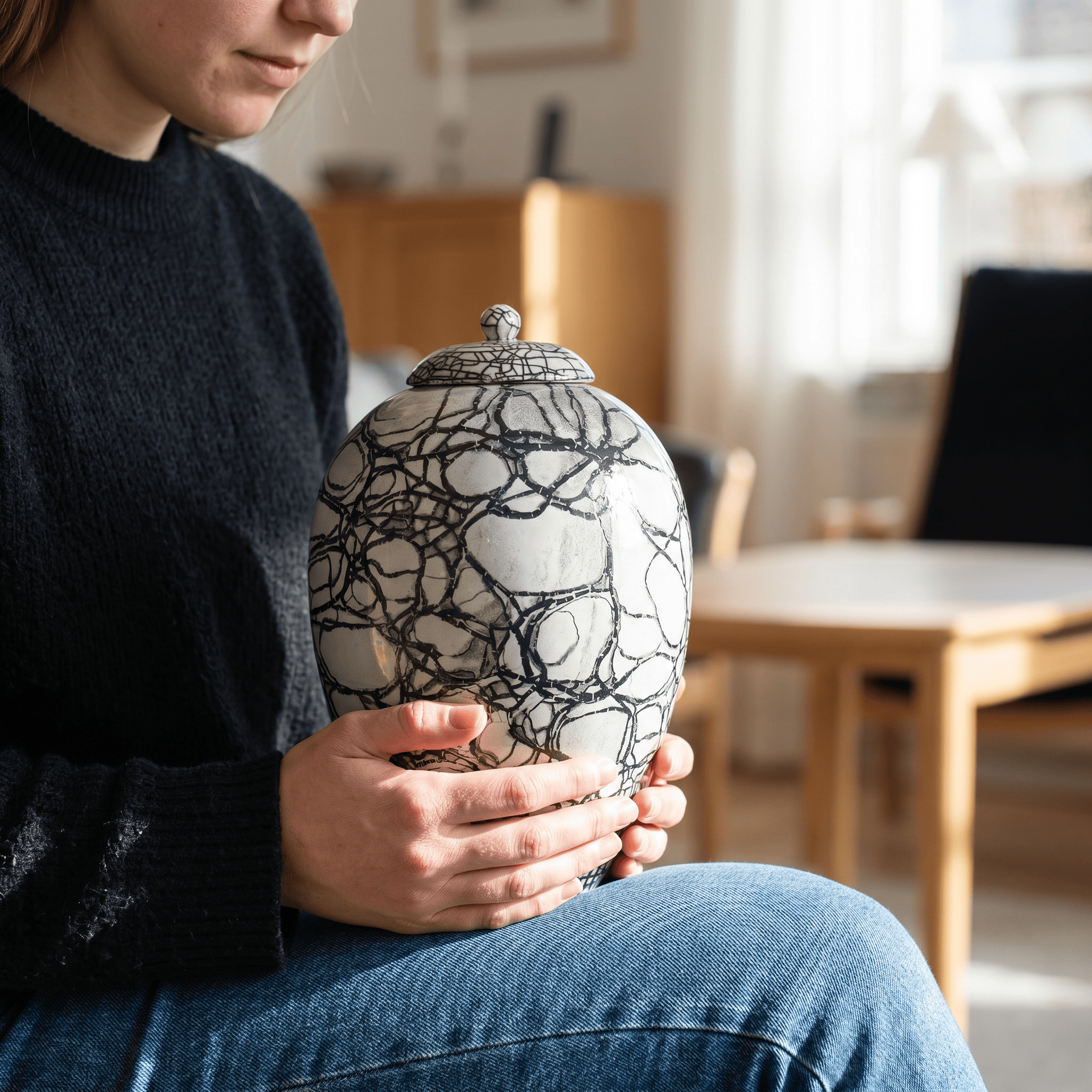
When Connection Needs a Form
Grief does not only live in the mind. It also lives in space, in objects, and in the quiet ways people continue to relate to someone who is no longer physically present. After a loss, one of the most important and deeply personal decisions families face is how to hold on to that connection in physical form.
Some people feel a strong need to have a place to visit—a cemetery, a memorial garden, a meaningful landscape, or a specific location where they can return again and again. Others feel more comfort in having something to keep—an object that remains within their home, integrated into everyday life and presence.
Both responses come from the same human need: to stay connected. But they express that need in different ways, shaped by personality, culture, memory, and the nature of the relationship itself.
Understanding this difference reveals something essential about grief: remembrance is not one experience, but many. The physical form it takes is not just symbolic—it actively shapes how people continue their emotional bond over time.
The Human Need for Place in Grief
Humans have always created places for memory. From ancient burial sites and sacred grounds to modern cemeteries, memorial gardens, and personal landmarks, location has always played a central role in how people process loss.
A place provides structure in a moment when life feels disrupted. It creates a destination where grief can be expressed externally rather than carried entirely within.
For many people, a place becomes:
-
a point of return during emotional moments
-
a physical structure for memory
-
a shared reference point for family members
-
a space where rituals naturally develop over time
-
a grounded connection to someone who is no longer physically present
A place allows grief to be externalized. Instead of holding everything internally, emotions can be directed toward a physical environment that remains stable while life changes around it.
It gives memory somewhere to exist in the world.

Why Some People Need Somewhere to Go
For many individuals, the act of visiting is not secondary—it is central to how they maintain connection.
Going to a specific place creates movement. That movement is meaningful: it transforms grief from something purely internal into something expressed through action.
People may visit to:
-
sit in silence and reflect
-
bring flowers or symbolic offerings
-
mark anniversaries or important life events
-
feel proximity through physical presence
-
reconnect with family members through shared remembrance
Over time, these visits become part of emotional rhythm. The place becomes familiar, not only physically but emotionally.
Season after season, the environment changes:
-
light shifts with the time of year
-
weather alters the atmosphere
-
nature grows and recedes
-
time leaves visible traces
And yet the memory remains anchored there.
A place becomes part of the ongoing relationship with loss. It is not static—it evolves alongside the person visiting it.
The Psychology of Place Attachment
The emotional importance of a place is deeply rooted in human psychology. People naturally form attachments to locations through experience, repetition, and emotional association.
A meaningful place often carries:
-
repeated emotional encounters
-
sensory memory (sound, light, smell, atmosphere)
-
symbolic meaning tied to a person or event
-
shared family experiences
In grief, this attachment becomes intensified. The mind links emotional memory to physical geography, creating a strong sense of “this is where I feel close.”
A place becomes more than a location—it becomes an emotional anchor.
It offers something stable in a world that feels altered.

The Importance of Ritual and Returning
Visiting a place repeatedly creates structure in grief, especially when life otherwise feels unpredictable.
Each return reinforces continuity. Even if emotions shift, the act itself remains familiar.
Over time, people begin to notice:
-
how the same space feels different at different times
-
how emotional intensity changes from visit to visit
-
how memory becomes layered with new life experiences
-
how presence is felt through absence
These repeated visits create a relationship not only with the memory, but with the place itself.
Grief becomes something that is revisited, not avoided or resolved.

Why Others Need Something to Keep
While some people find comfort in visiting a place, others feel more grounded when they have something they can keep close.
This may take many forms:
-
a personal belonging
-
a photograph
-
a handwritten letter
-
a piece of clothing or jewelry
-
a memorial urn or keepsake object
Unlike a place, an object does not require distance, travel, or planning. It exists within daily life, accessible at any moment.
It becomes part of the environment where life continues.
For many, this creates a different kind of connection—one that is continuous rather than periodic.

The Emotional Meaning of Keeping Something Close
Physical objects carry a presence that is fundamentally different from locations.
They have:
-
weight and texture
-
physical permanence
-
immediate accessibility
-
tactile connection
These qualities matter because grief is not only emotional—it is also physical. The body often seeks grounding when faced with absence.
An object provides that grounding in a direct way.
It does not represent memory from a distance. It exists alongside it.
Even in silence, it holds meaning simply by being present.
Home as a Space of Remembrance
For those who keep memorial objects nearby, the home often becomes an unintentional but meaningful space of remembrance.
This does not usually involve formal structure. Instead, remembrance becomes woven into everyday life.
A memorial object may naturally become part of:
-
a living room
-
a personal shelf or cabinet
-
a quiet corner of reflection
-
a shared family space
Its presence is subtle but constant.
Unlike a place that must be visited, it is always there—integrated into ordinary moments.
This creates a different emotional rhythm: remembrance becomes continuous rather than occasional.

Public Remembrance and Private Remembrance
One of the key differences between places and objects is how they shape the social nature of grief.
A place is often public or shared. It can bring families together, support rituals, and create collective memory across generations.
A personal object is often private. It supports individual reflection, quiet connection, and personal emotional processing.
Both are meaningful, but they serve different roles:
-
places connect memory to community and shared ritual
-
objects connect memory to intimacy and daily presence
Neither is more valid or more “correct.”
They simply reflect different emotional expressions of connection.
When Families Grieve Differently
One of the most important but often unspoken aspects of grief is that people within the same family can experience it differently.
After the same loss:
-
one person may feel a strong need to visit a physical location
-
another may prefer keeping something close at home
-
another may process grief through storytelling or ritual
These differences do not reflect differences in love or attachment.
They reflect differences in emotional processing, personality, and coping style.
Grief is shared, but not identical.
This is why families sometimes find that multiple forms of remembrance can coexist without contradiction.

Objects Preserve Identity, Not Only Memory
Memorial objects often carry meaning far beyond remembrance itself. They can preserve a sense of identity.
They may reflect:
-
personality traits
-
values and beliefs
-
emotional presence
-
habits and daily life
-
the feeling of “who someone was”
This is why certain objects feel irreplaceable. Their significance is not based on material value, but relational meaning.
A simple object can hold an entire emotional history.
It becomes a way of preserving not just that someone lived, but how they lived.
How Remembrance Changes Over Time
Grief evolves, and so does the way people choose to remember.
In early stages, a physical place may feel essential because it provides external structure and a defined point of focus.
Over time, that need may change:
-
some people shift toward more integrated, daily forms of remembrance
-
others move from private objects toward shared family spaces
-
some maintain both simultaneously, in different emotional roles
These changes do not indicate inconsistency. They reflect emotional development over time.
Memory adapts as life continues.
Time-Triggered Emotional Shifts
Even years after a loss, grief can resurface in unexpected ways.
Certain life events often reawaken emotional awareness:
-
weddings, births, or new family milestones
-
anniversaries of loss or significant dates
-
major life transitions such as relocation or retirement
-
moments of personal reflection or change
These experiences often lead to quiet internal questions:
“Is this still how I want to remember them now?”
Memory is not fixed. It interacts with ongoing life experience, continuously reshaping meaning.
The Role of Silence and Space in Remembrance
Whether through a place or an object, silence plays an essential role in grief.
Silence allows memory to surface without interruption or explanation.
A place offers silence within an external environment—open, physical, and shared with nature or surroundings.
An object creates silence within a personal environment—intimate, close, and integrated into daily life.
Both forms allow grief to exist without pressure to resolve or justify itself.

Why There Is No Single Right Way to Remember
Modern remembrance is increasingly understood as personal rather than prescribed.
There is no universal structure that fits every emotional experience.
Some people need distance and destination.
Some need closeness and presence.
Some move between both over time.
What matters most is not the form of remembrance, but whether it supports connection in a meaningful way.
The Psychology of Continuing Connection
At its core, both place-based and object-based remembrance arise from the same psychological foundation: the need for continuing bonds.
Human attachment does not end with physical absence. It transforms.
A place allows connection through return.
An object allows connection through presence.
Both help the mind integrate loss while maintaining emotional continuity.
They do not replace absence—they reshape how absence is experienced.
Different Forms of the Same Bond
Whether someone needs a place to visit or something to keep, the underlying need is the same: to remain connected to someone who mattered deeply.
A place offers somewhere to go.
An object offers something that stays.
One creates distance, movement, and return. The other creates closeness, continuity, and presence.
Both are physical expressions of memory, shaped by human emotion and the need for connection.
Grief does not have a single shape, and remembrance does not have a single form. The ways people choose to remember—through places, objects, rituals, and personal spaces—become part of how love continues beyond loss.
In the end, places and objects are not opposites. They are different expressions of the same human truth: that connection does not end when presence changes—it simply finds new forms in which to remain.
Share:
Comparing Memorial Urns for Human Ashes and Pet Urns: Key Differences
How Families Create New Traditions After Loss: The Evolution of Remembrance Rituals